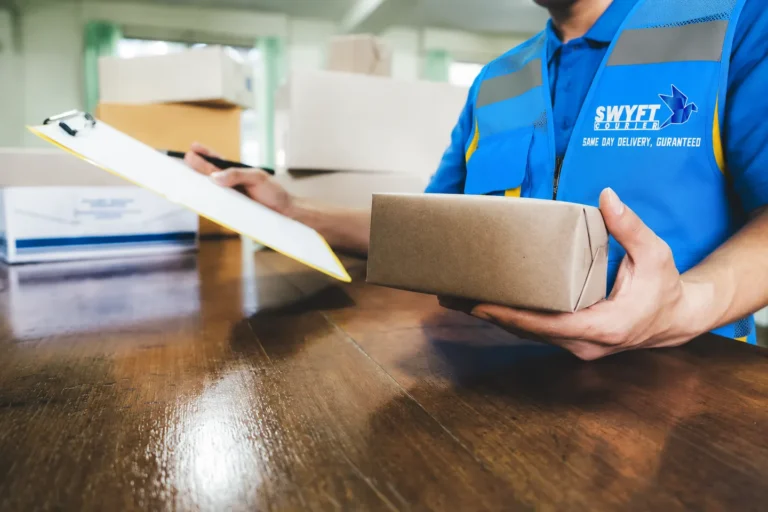
Cutting the environmental footprint of local deliveries in Metro Vancouver does not come from vague green badges—it comes from reducing vehicle kilometres per parcel. Across the Lower Mainland, four operational levers make a real difference: consolidating orders into fewer pickups, preventing failed redelivery trips, right-sizing packaging, and matching each shipment to the right carrier model.
Honesty matters too: Swyft Courier does not publish claims about electric fleets, bike couriers, or carbon-offset programs on its service pages. Instead of greenwashing, this guide focuses on practical steps any Vancouver shipper can use today—and fairly compares Lower Mainland delivery models, including zero-emission cargo trikes.
1. Consolidate Orders Instead of Booking One-Off Runs
Every separate ad-hoc pickup adds approach kilometres before a parcel even heads toward its recipient. Replacing three scattered afternoon bookings with one planned morning pickup reduces total driving distance and per-drop cost together.
- Batch routine drops into morning windows: Releasing non-urgent Metro Vancouver shipments in Swyft’s 9:00 AM to 12:00 PM weekday ready window (Economy or Flat Rate) or 9:00 AM to 2:00 PM Standard window supports cleaner multi-stop routing across Vancouver, Burnaby, Richmond, and Surrey.
- Combine multi-piece orders: Bundling multiple items headed to the same site on one booking—or scheduling recurring pickups through a corporate account—cuts duplicate vehicle trips.
- Consolidate province-wide shipments: Group non-urgent parcels headed outside the Lower Mainland onto evening pickups with BC next-day delivery rather than booking solo long-distance drives.
2. Direct Local Routing vs. Multi-Hub Warehouse Relays
A parcel’s travel distance depends heavily on carrier architecture. Through a national hub-and-spoke network, a box going from Mount Pleasant to Burnaby or Richmond is typically collected by one van, driven to a regional sorting hub, sorted overnight, and loaded onto a second delivery vehicle the next day.
Direct local couriers follow a shorter operational chain: one vetted driver routes shipments across the Lower Mainland (Whistler to Hope) with no intermediate sorting warehouse transfers or air-freight relays, cutting unnecessary handling legs on same-day deliveries.
3. Prevent Failed Deliveries and Redelivery Kilometres
Missed first-attempt drops are among the most avoidable sources of extra urban mileage. Driving a parcel back to the sender or attempting delivery again the next day doubles last-mile distance while adding return (+50% next day, +100% same day) or redelivery (+100% next day) fees.
- Verify street numbers, suite numbers, and Canadian postal codes with geolocation address validation at booking.
- Include condo buzzer codes, concierge hours, and commercial loading-dock directions in delivery notes.
- Share the public Swyft live GPS tracking link (no app or login required) so recipients are ready when the driver arrives.
- Choose a clear Delivery Preference rather than leaving it on the default Leave outside when a hand-to-hand drop is necessary.
4. Right-Size Packaging to Save Cargo Space
Measure each sealed parcel and provide its weight. Swyft’s published standard weight allowance is 35 lb, with a $1 per lb charge over that allowance. Confirm the size charge in your quote.
5. Compare Lower Mainland Delivery Models Honestly
No single courier is the lowest-emission choice for every distance and weight. Matching each shipment to the right Metro Vancouver model gives you the best real-world result:
| Delivery Model & Examples | Coverage & Network | Emissions & Routing Profile | Best Fit For |
|---|---|---|---|
| Zero-Emission Cargo Trike Specialist (Shift Delivery Co-op) | Central Vancouver focus; worker-owned cargo-trike co-op | Zero tailpipe emissions on electric-assist cargo trikes within central city routes | Light-to-medium local deliveries inside central Vancouver where zero-emission transport is the priority |
| Local Bike & Messenger Couriers (Phantom Couriers, PDX Courier) | Downtown Vancouver bike messengers (Phantom) alongside Metro Vancouver vehicle rush runs | Zero tailpipe emissions on bicycle runs; standard vehicle transit on longer regional runs | Urgent small envelopes and compact parcels inside dense downtown Vancouver corridors |
| Direct Regional Local Courier (Swyft Courier) | Metro Vancouver and Lower Mainland (Whistler to Hope), BC next-day, Canada-wide freight; single vetted driver | No public EV fleet or carbon-offset claims; eliminates multi-hub warehouse relays via direct local routing and batched pickups | Cross-municipality Lower Mainland business runs, heavier or bulky loads (35+ lb), and consolidated corporate pickups |
| National Hub-and-Spoke Carriers (Canada Post, Purolator) | Canada-wide postal and parcel networks using regional sorting hubs | High stop density on established multi-day routes, though local metro parcels pass through sorting hubs | Non-urgent letters, small residential parcels, and nationwide shipping across Canada |
Frequently Asked Questions
What does Swyft Courier publicly state about its fleet and emissions?
Swyft Courier does not publish electric vehicle fleet targets, bike courier services, or carbon-offset certifications on its commercial pages. If zero-emission cargo-bike transit in central Vancouver is a strict requirement for your parcel, a dedicated co-op such as Shift Delivery Co-op is purpose-built for that job.
How does batching orders reduce last-mile delivery emissions?
Grouping multiple local shipments into one scheduled pickup eliminates separate deadhead trips to and from your office. Releasing routine orders in a 9:00 AM to 12:00 PM weekday ready window lowers vehicle kilometres per parcel and qualifies for Economy or Flat Rate pricing.
Why does direct local routing involve fewer transfer legs than hub-and-spoke shipping?
National hub-and-spoke carriers collect local parcels, move them to a regional sorting facility, and reload them onto a second vehicle the next day. Direct local couriers carry shipments point to point within Metro Vancouver without intermediate warehouse transfers or air-freight relays.
How do failed deliveries increase shipping emissions?
When a driver cannot complete a first-attempt handoff due to a missing buzzer code, closed reception, or wrong address, the parcel requires a return trip or next-day redelivery—roughly doubling last-mile kilometres while adding 50% to 100% in return or redelivery fees.
Plan Efficient Local Deliveries Across Metro Vancouver
Ready to book a batched or direct local pickup? Check upfront pricing in under a minute on our booking portal—no account needed.
Looking to consolidate recurring Lower Mainland runs into a regular schedule? Call our Vancouver team at (778) 251-5771 (Monday to Sunday, 9:00 AM to 6:00 PM Pacific), review starting flat rates, read how our ready-time windows work, or message us on our contact page.